

On July 14, 2026, the European Commission published its report reviewing the Foreign Subsidies Regulation’s (FSR) first three years of operation.[1] The Commission found the regime “fit for purpose” and an “effective tool” to tackle distortions from foreign subsidies in the EU single market. However, it also recognized broad concerns about the regime’s efficiency and the disproportionate cost of compliance.
In response, the Commission will propose targeted changes to streamline the regime. These include higher notification thresholds for merger filings and a simpler filing form for public tenders. The Commission will publish its detailed proposals in the fall and intends to adopt them in 2027.
This review was conducted pursuant to the Commission’s duty to evaluate the FSR’s implementation and enforcement and report to the European Parliament and Council every three years (Article 52(2) FSR).
Merger Notifications
The Verdict
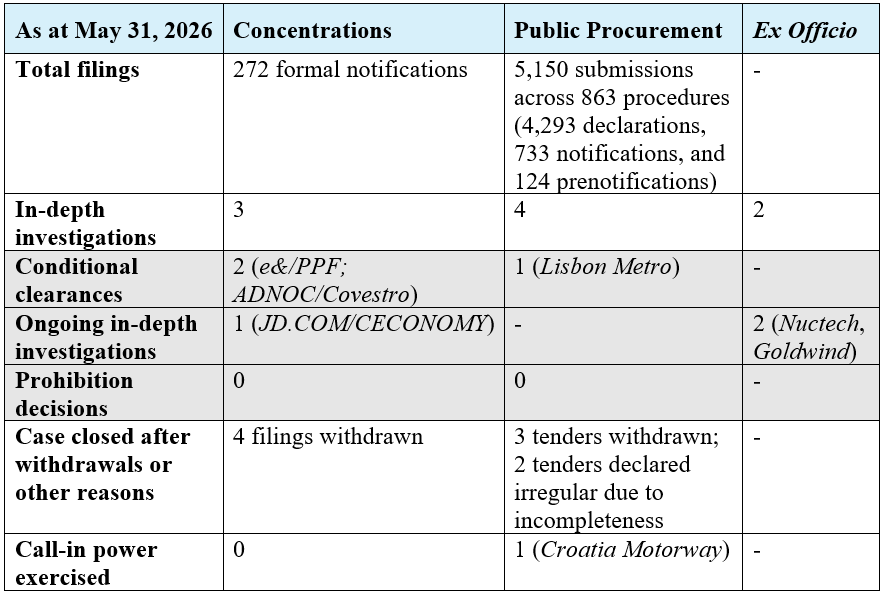
The FSR has caught far more transactions than anticipated (averaging 100 per year) while the intervention rate is extremely low: 99% of mergers
were cleared without an in-depth review.[2] In 20% of these cases, the filings did not report any foreign financial contributions (FFCs) as these all fell within the reporting exemptions. The case for simplification is clear, with the Commission promising to tighten several reporting thresholds.
Proposed Changes
The Commission is considering changes that would (a) reduce the overall number of notifications and (b) further streamline filing requirements. These include:
- Raising the turnover notification threshold, reportedly to €600 million;[3]
- Introducing a simplified process for low-risk mergers or FFCs;
- Increasing the thresholds for reportable FFCs in the merger filing (currently €1 million for individual FFCs and €45 million by country); and
- Introducing new exemptions for reportable FFCs in the filing.
Practical Experience
The review revealed FSR merger review has become more efficient over time, although parties still reported substantial burdens associated with FFC data collection and the scope and level of detail required by Commission RFIs.[4] Accordingly, there remains substantial scope for simplification.
- Review timelines are short but preparation time varies. Prenotification takes between one to two months on average, which likely reflects that most filings do not raise substantive issues.[5] During this process, parties should expect to answer several rounds of questions, with 31% of stakeholders receiving at least three RFIs during prenotification.[6] Despite the relatively swift review, many parties still experience delays to their deal timetables, which likely reflects the effort involved in filing preparation. For 41% of stakeholders, the FSR process involved additional weeks of waiting, 20% reported substantial extensions of several months, while 39% reported no or only minor delays that were easily managed within the overall schedule.[7]
- Greater transparency needed on waivers. While waiver requests appeared common (they were reportedly made in 39% of cases), the Commission did not reveal how many were granted. Most stakeholders surveyed felt that prenotification discussions did not reduce the information they needed to provide, or only in limited ways.[8]
- Private fund filings remain numerous and burdensome. Private equity and investment fund acquirers represent over 30% of all filings, where the most common FFCs reported were limited partner contributions by state-linked investorsmade on pari passu terms, equivalent to those of private investors.[9] From this body of experience, the Commission recognizes that private fund filings generally do not raise concerns, with “limitedpossibilities for cross-subsidization of the transaction (both at acquisition level and activity post-transaction)”.[10] The Commission has created a reporting exemption for fund filings which has alleviated some of the reporting burden.[11] However, most stakeholders have found this difficult to apply.[12] This has led the Commission to issue new guidance allowing aggregated reporting of pari passu limited partner interests (Question 26 of its FAQs). The Commission is now reportedly considering further changes that could exempt certain limited partner contributions and portfolio company FFCs from the reporting perimeter.
Public Procurement Notifications
The Verdict
The Commission considers the regime “operational and achieving its core objectives”, despite “substantial bottlenecks” in its practical application. Out of 5,150 submissions across 863 procurement procedures worth over €712 billion, the Commission has opened only four in-depth investigations.[13] The Commission has also used its below-threshold call-in power in one tender, which ultimately led to the exclusion of the targeted operator.[14]
Proposed Changes
The Commission will maintain the €250 million contract value threshold for notification (€125 million for lots), citing mixed feedback that did not point in a clear direction.[15] Instead, it will focus on simplifying the filing process and addressing awareness gaps among companies and contracting authorities. The proposed changes include:
- simplifying and clarifying the notification and declaration forms;
- revising the waiver framework;
- clarifying and limiting the reporting of “non-distortive” FFCs; and
- clarifying the rights and obligations of bidders and contracting authorities, including on the processing of confidential data.
DG GROW also aims to improve procedural transparency, although the report stops short of promising a public case registry similar to merger filings.[16] DG GROW is actively developing a set of internal administrative tools to ensure effective and timely handling of cases, including a dedicated notification and registration system to support streamlined processing and traceability.[17]
Practical Experience
The review highlights persistent compliance shortcomings and significant procedural burdens for bidders navigating the public procurement regime.
- Compliance has fallen over time and filings are frequently deficient. While the number of filings increased rapidly at the FSR’s introduction, the compliance rate appears to have declined over time, based on a comparison of qualifying tenders with notifications received by the Commission.[18] 40 economic operators accounted for 16% of all submissions received (672 in total).[19] Filings were also frequently incomplete or incorrectly submitted as declarations. Common omissions included ownership structures, financial statements, and an appropriate description of FFCs granted to group entities in scope (holding and subsidiary companies of the economic operator).
- Tight time limits and uneven reporting present significant procedural challenges. The public tender review process is highly compressed. Due to time constraints, economic operators are generally unable to engage in prenotification contacts so shortcomings are addressed during preliminary review. This means the Commission devotes significant time to gathering missing information, leaving limited scope for conducting a thorough substantive assessment.[20] The Commission issued 1.75 RFIs on average per case, with a typical response deadline of four working days.[21] Contracting authorities may compound the procedural difficulties by failing to request filings, transmitting them late – including, in a few cases, after awarding the contract – or imposing non-standard requirements.[22]
- The FSR has deterred contractors from tendering. The Commission has observed economic operators adapting their contracting behavior to avoid FSR review, including by withdrawing from tenders, only bidding in procedures below the €250 million threshold, or shifting from consortium member to subcontractor or supplier status. The Commission views this as evidence of the FSR’s deterrent or “filtering” effect, rather than a response to FSR compliance costs.[23]
Ex Officio Investigations
The Verdict
To date, the Commission has opened two in-depth investigations under the ex officio tool, and has an undisclosed number of cases in preliminary review. The review considers the ex officio regime to be “function[ing] asintended”,[24] although stakeholders raised concerns that investigations are slow and unpredictable, and that the Commission provides little transparency on how it selects and prioritizes cases.
Proposed Changes
The Commission is not considering any changes to its ex officio powers. However, it intends to keep improving transparency and to provide further insights into its approach under the ex officio regime.[25] Notably, there are no plans to introduce statutory deadlines for the preliminary review phase or to publish guidance on prioritization criteria.
Practical Experience
While general experience with the ex officio tool remains limited, given the few cases opened to date, the review revealed these common observations.
- Enforcement is slow-moving with uncertain timelines. The only two in-depth ex officio cases, Nuctech[26] and Goldwind,[27] were both initiated in April 2024, and it took roughly 20 and 22 months respectively before they progressed to an in-depth investigation.[28] Neither case has yet been concluded. The Commission maintains that these timelines are not remarkable as the length of the investigation depends on the level of complexity of individual cases, the degree of cooperation by the undertakings under investigation, and on actions brought before the EU Courts.[29] It also observes that the 18-month maximum target duration for in‑depth investigations (under Article 11(5) FSR) has not yet expired in these cases. Still, the lack of fixed deadlines for the Commission to complete its preliminary and in-depth investigations creates uncertainty for investigated parties and stakeholders, who have limited visibility over the timing and the progress of cases.
- Case selection remains opaque. Given the broad scope of the ex officio powers, several stakeholders called for greater transparency and guidance on the circumstances in which ex officio investigations are initiated and how prioritization decisions are taken.[30] The Commission referred to the summary notices published in the Official Journal when in‑depth investigations are opened and considered that any published decisions will bring clarity over its enforcement practice.[31] It remains to be seen whether these decisions will have sufficient detail to help businesses assess what may attract scrutiny.
Takeaways for Business
- Preparation remains key to a smooth filing process. The Commission’s planned changes are expected to reduce the FSR compliance burden. Given the non-routine nature of FFC data, however, it remains important for businesses to prepare for filings before the need arises. Businesses should assess their likely reporting obligations and develop a plan for collecting relevant information. This will also help in evaluating timing implications and substantive risks early in the deal timeline.
- Anticipate more rigorous and intense enforcement. The Commission is expected to intervene in more cases as it builds capacity, invests in improved systems, and frees up resources from routine filings. Businesses should prepare by undertaking risk assessments of their exposure to distortive subsidies, particularly if operating in sensitive sectors. Businesses that participate in public tenders should treat FSR-readiness as a bid-eligibility issue, be prepared with data collection, and consider credible replacement options where consortium members or subcontractors and suppliers may attract scrutiny.[32]
- Engage in the forthcoming consultation. Companies should consider providing feedback on the Commission’s proposed changes when they are published, to help ensure they reflect commercial realities and deliver real compliance savings.
FSR Enforcement In The First Three Years
[1] Report from the Commission to the European Parliament and the Council, COM(2026) 368 final (“Report”), accompanied by the Commission Staff Working Document accompanying the Report from the Commission to the Parliament and Council, SWD(2026) 183 final (“SWD”). The Report follows the publication of the European Commission’s Staff Working Document accompanying the FSR Guidelines on June 30, 2026 (see Cleary’s alert memorandum: The FSR Guidelines: What the Commission’s Staff Working Document Reveals July 16, 2026, accessible here). While the latter provides insights for future FSR substantive assessments, the Report addresses the entire FSR framework itself.
[2] Based on 272 notified cases as at May 31, 2026, of which only three cases have been subject to an in-depth review (with one still pending at the current time).
[3] This is the maximum increase to the thresholds (20%) the Commission may enact as a delegated act under the FSR, which do not require specific Council and EU Parliament approval (Article 49(1)). The Commission estimates this would lead to a 16% reduction in the number of FSR merger notifications. SWD, p.33.
[4] SWD, p. 37.
[5] SWD, pp. 35. Based on the latest available figures (for October 2024 to April 2025), prenotification periods are 24 working days (median) and 35 working days (average). In the first six months (September 2023 to March 2024), they were 36 working days (median) and 42 working days (average).
[6] Study on the Simplification and Review of the FSR (“FSR Study”) annexed to the SWD, accessible here, p. 22 and Table 2.
[7] FSR Study, p.27 and Figure 6. These figures covered both mergers and procurement timelines.
[8] FSR Study, Annex I of the SWD, p. 19 and Figure 3. The results encompass feedback across the mergers and public procurement regimes but there were only a low number of procurement survey respondents.
[9] SWD, p.30-31. Across all the private equity/investment fund filings notified, all capital contributions by state-linked investors have been on pari passu terms.
[10] SWD, p. 30.
[11] FSR Study, p. 59, Table 33. 56% of stakeholders found the exception significantly decreased the overall reporting burden, 28% of stakeholders disagreed, while 16% were neutral.
[12] FSR Study, p.58-59 and Table 3.
[13] Report, pp. 8-10.
[14] Report, pp. 9-10. This was Case FSP.103175 – Croatia Motorway.
[15] Q&A on the first FSR review, Questions 7-8.
[16] Report, p. 3, fn. 11.
[17] SWD, p. 51.
[18] SWD, p. 45. The Commission received at least one submission for only 45% of qualifying public procurement procedures (based on TED data) in the period October 2025 to January 2026, compared to 70% for the period October 2024 to September 2025.
[19] SWD, p. 46.
[20] SWD, p. 56.
[21] SWD, pp. 50-51. Based on a sample size of 30 cases. Each RFI included on average three questions, with significant variation ranging from one to 10 questions.
[22] SWD, pp. 45-46.
[23] SWD, pp. 55-56.
[24] Report, p. 6.
[25] Report, pp. 11-12.
[26] Nuctech (Case FS.100068), Commission decision of December 11, 2025.
[27] Goldwind (Case FS.100143), Commission decision of February 3, 2026.
[28] SWD, p. 24.
[29] Report, pp. 6 and 11; SWD, pp. 24-25 and 60.
[30] SWD, p. 25.
[31] SWD, pp. 25 and 60.
[32] Commission Report, pp. 9-10.